Most organizations aren’t short on CRM technology. They’re short on trust.
After two decades of relentless optimization — automation, dashboards, and AI-assisted workflows — CRM systems have never been more capable. Yet many executive teams quietly admit they don’t believe what their CRM is telling them. Reports are polished, but confidence is low.
That’s the paradox of the modern CRM: it’s efficient, but it’s not trusted. And that gap between data and belief is where most transformation efforts stall.
The next era of CRM won’t be defined by new features. It will be defined by trust — the kind that allows leaders to treat CRM not as a reporting mechanism, but as a system of organizational truth.
How We Got Here: The Efficiency Era and Its Limits
The last decade of CRM evolution was built on one premise: more automation equals more productivity. Every enhancement — from activity tracking to pipeline scoring — promised efficiency. And in many ways, it delivered. Sales teams log more, marketing can see more, and operations can forecast more.
But efficiency has a limit. A system can be fast, structured, and technically sound — yet still fail the organization that uses it.
Why? Because efficiency only optimizes the mechanics. It doesn’t address the relationship between people, data, and leadership. When CRM becomes a tool for compliance rather than clarity, efficiency erodes trust. The result is a familiar pattern: adoption fatigue, inconsistent data, and leadership reports that no one fully believes.
The Trust Gap: When Efficiency Outpaces Alignment
Executives rarely mistrust CRM out of cynicism. They do it out of experience. They’ve seen dashboards that don’t match reality. They’ve heard teams describe work that isn’t visible in the system. They’ve witnessed revenue forecasts that shift overnight.
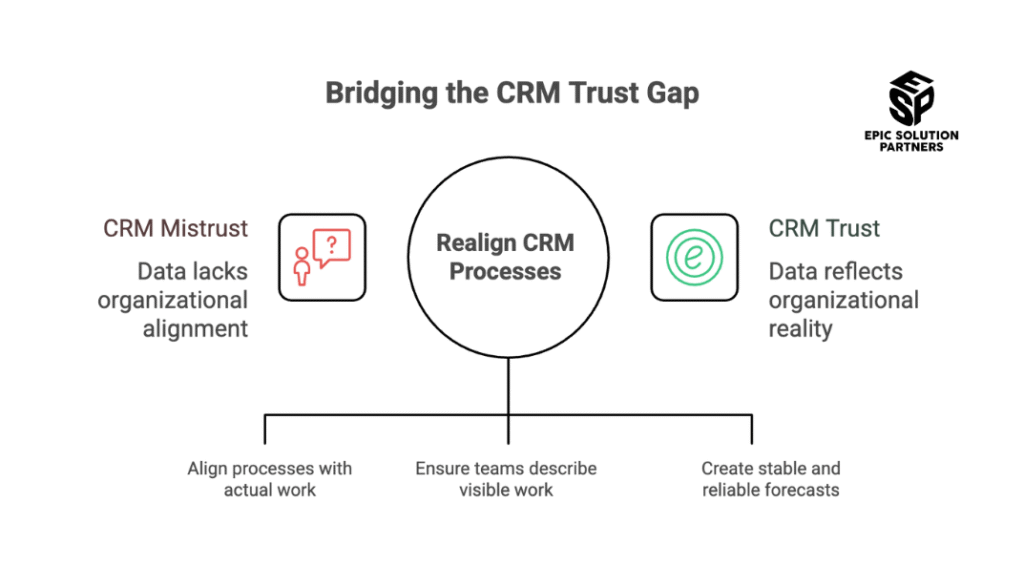
This isn’t a data problem — it’s an alignment problem. CRM stopped reflecting how the organization actually works. Processes were codified faster than culture could adapt.
The result:
- Teams see CRM as administrative overhead.
- Leadership treats CRM data with skepticism.
- Technology teams maintain a system that nobody fully believes in.
As one CIO put it: “We have the data. We just don’t have confidence in it.”
That’s the real issue — data doesn’t create trust. Alignment does.
The Shift: From Efficiency to Executive Trust
Building executive trust in CRM starts with redefining what success looks like. It’s not about system speed or user compliance. It’s about whether leadership can look at the data and say, “Yes, this reflects how we actually operate.”
That trust emerges when three layers align:
- System Clarity — CRM mirrors the real structure and priorities of the business, not an outdated process map.
- Cultural Adoption — Teams understand how their input creates visibility and accountability. They see value, not surveillance.
- Leadership Connection — Executives use CRM not to manage activity, but to generate shared understanding and guide better decisions.
When these layers converge, CRM evolves from a repository into a relationship system — connecting teams through shared truth.
Building Toward Trust: What the Next Era Looks Like
The future of CRM isn’t about doing more. It’s about believing more.
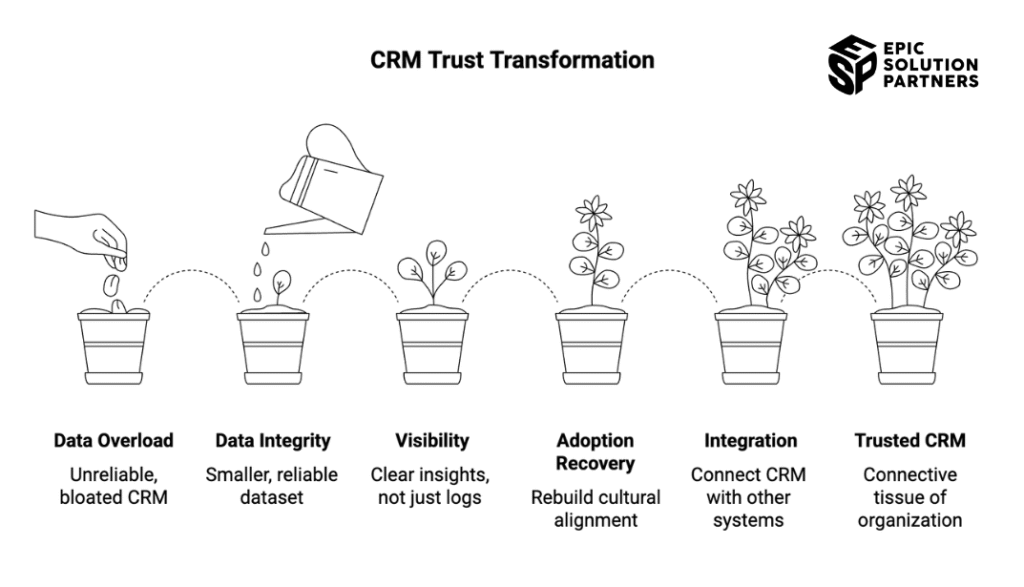
1. Data Integrity Over Data Quantity
Organizations don’t need more data points — they need more reliable ones. A smaller, well-governed dataset that leaders actually trust is more valuable than a bloated CRM filled with outdated records.
2. Visibility Over Volume
Leaders need clarity, not noise. A well-designed CRM surfaces insights—not just activity logs—helping teams align decisions with business outcomes.
3. Adoption Recovery Before Automation
You can’t automate what people don’t trust. Before layering on new tools or AI models, organizations must rebuild cultural alignment around the CRM — reconnecting teams to its purpose.
4. Integration as a Trust Multiplier
Trust grows when systems talk to each other. Integrating CRM with finance, operations, and project systems connects data to outcomes — transforming CRM from an isolated system into the organization’s connective tissue.
The Executive Imperative: Designing for Trust
The shift from efficiency to trust is not a technical upgrade — it’s a leadership one.
Executives must ask:
What would it take for me to fully believe my CRM again?
That question reframes the agenda from tools to truth. It invites leaders to design for confidence — through clarity, communication, and consistent use at the top.
When leaders treat CRM as a shared accountability framework rather than a data-entry task, the system regains its intended power: visibility, coherence, and connection.
Trust as the True ROI
The ROI of CRM has long been measured in productivity metrics — time saved, leads tracked, emails logged. But the actual return comes when leadership can make confident, data-informed decisions that unify teams around reality.
Efficiency was the last era’s goal. Trust is the foundation for the next one.
When executives believe in their CRM, the organization believes in itself — because everyone is finally seeing the same truth.
At Epic Solution Partners, we help organizations rebuild confidence in their systems and teams — guiding CRM from a reporting tool to a trusted source of leadership insight.