A sales director pulls up the quarterly forecast and sees three different revenue numbers for the same period. Each came from a trusted system. None are obviously wrong. The meeting stalls while teams reconcile the discrepancy.
This scenario is common, and it didn’t happen overnight. Data quality rarely fails loudly. More often, it degrades slowly, through small inconsistencies, shifting definitions, and incremental changes in how systems are used. By the time it becomes visible, confidence has already eroded. Reports are questioned. Teams maintain parallel sources of truth. Systems that were intended to create alignment begin to introduce friction instead.
At that point, many organizations respond with a cleanup initiative. Records are reconciled, gaps are addressed, and the data improves. For a time.
What follows is usually familiar: the same issues resurface months later, despite good intentions and capable teams. This pattern is not a reflection of effort or competence. It reflects a structural misunderstanding of how data behaves inside a living organization.
Key Takeaways
- Data quality issues emerge when ownership and stewardship are unclear—one-time cleanups improve conditions temporarily but degrade without an operating model to sustain them.
- Treating data quality as an ongoing organizational capability supports trust, alignment, and faster decision-making across reporting, analytics, and AI initiatives.
- Mature organizations invest in clear standards, explicit accountability, and active stewardship to keep data aligned as systems and teams evolve.
Cleanup as a Practice, not a Moment
Data does not remain static after a cleanup effort concludes.
New records are created daily. Integrations evolve. Teams adapt workflows to meet changing demands. Each of these changes introduces variation. Without clear ownership and shared expectations, that variation accumulates.
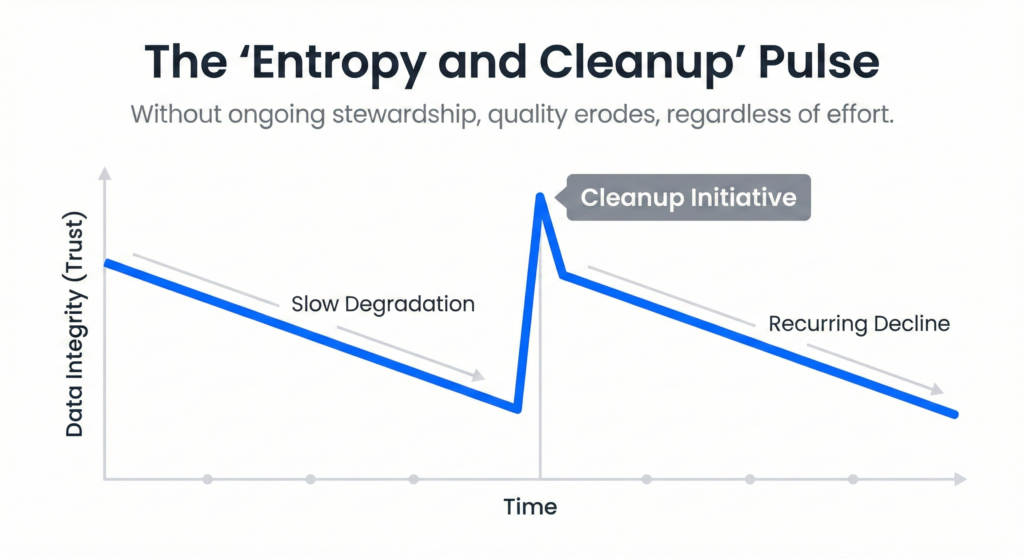
Even well-run cleanup efforts tend to assume stability where none exists. They address the current state without establishing the mechanisms required to maintain it. Over time, quality declines not because people are careless, but because responsibility was never clearly defined beyond the project itself.
This is why organizations can invest significantly in CRM platforms, analytics tools, or AI initiatives and still feel constrained by the outputs. The issue is rarely the technology. It is the absence of an operating model for maintaining data quality over time.
Treating Data Quality as an Operating Capability
The alternative is not more technology or more intensive cleanup efforts. It is a shift in how data quality is understood and maintained.
Organizations that make sustained progress approach data differently.
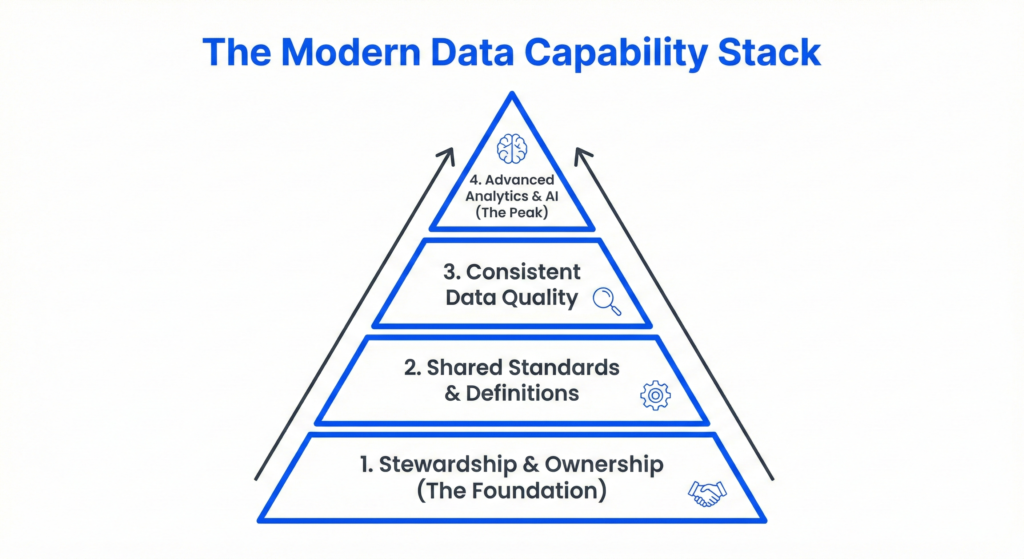
They recognize data quality as an ongoing capability—one that requires intention, clarity, and continuity. This does not imply heavy governance structures or constant intervention. In practice, it involves a small number of consistent disciplines applied thoughtfully.
What This Looks Like in Practice
Clear ownership matters. So do shared definitions that reflect how the business actually operates, not how it was once documented. Entry standards, integration rules, and data lifecycle expectations must be explicit enough to guide behavior without becoming burdensome.
One technology company we worked with assigned data stewards across their core systems—not as full-time roles, but as explicit accountability within existing teams. These stewards conducted quarterly reviews with stakeholders, flagged emerging inconsistencies before they spread, and maintained living documentation of business rules. The result was not perfection, but sustained confidence that degraded far more slowly than before.
Most importantly, someone must be accountable for maintaining alignment as systems, processes, and teams change. Without stewardship, even well-designed standards lose relevance.
Confidence, Alignment, and Decision-Making
The impact of data quality is often most visible in leadership conversations.
When data is trusted, discussions move quickly. Decisions are grounded. Energy is spent on action rather than reconciliation. When trust erodes, meetings slow down. Numbers are qualified. Context must be rebuilt repeatedly.
Over time, this dynamic affects more than reporting. It influences how teams collaborate, how priorities are set, and how confidently leaders can act. Data becomes something to work around rather than something to rely on.
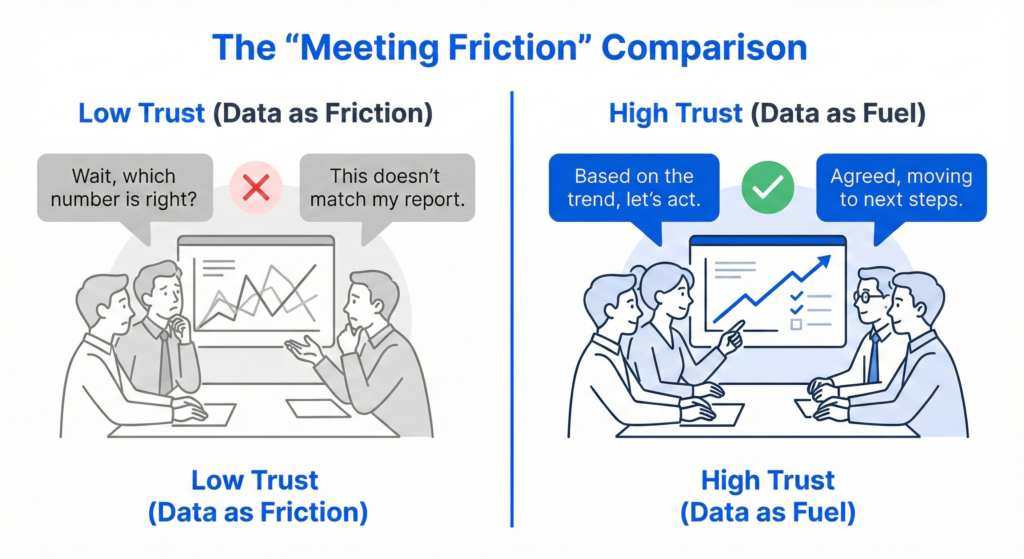
Ongoing stewardship helps preserve alignment by ensuring systems continue to reflect reality as it evolves. It creates continuity in environments that are otherwise in constant motion.
Implications for Reporting and Advanced Analytics
Interest in advanced reporting, automation, and AI continues to grow across organizations of all sizes. These capabilities can provide meaningful value when built on reliable foundations.
What is often underestimated is how directly their effectiveness depends on data discipline. Advanced tools do not resolve inconsistencies in underlying information. They surface them more quickly and at greater scale.
Organizations that succeed with analytics and AI typically invest earlier in data fundamentals. They establish consistency, clarify ownership, and maintain quality over time. As a result, advanced capabilities extend insight rather than introduce new uncertainty.
How Mature Organizations Approach the Work
Organizations with strong data practices tend to share certain characteristics.
They view data as a shared organizational asset rather than an IT artifact. They revisit standards as the business evolves. They assign responsibility for stewardship instead of assuming it will emerge organically. They address quality issues proactively, before confidence is lost.
Concrete Practices That Support This
- Designated data stewards with explicit accountability for specific systems or domains, typically as part of existing roles rather than new headcount.
- Data quality reviews on a regular interval. Depending on how dynamic the data is, we often recommend something more regular.
- Living documentation of business rules, field definitions, and integration logic that evolves alongside the business rather than becoming outdated artifacts.
- Clear escalation paths when inconsistencies are discovered, so teams know how to resolve issues quickly rather than working around them.
This approach reduces friction across systems and allows technology investments to deliver their intended value. Over time, data becomes an enabler of execution rather than a source of ongoing debate.
Sustaining Confidence Over Time
Improving data quality does not require constant intervention, but it does require continuity.
Moving beyond periodic cleanup toward ongoing stewardship allows organizations to maintain confidence as conditions change. Systems remain usable. Reporting remains credible. Leadership decisions are supported rather than slowed by the information available.
For organizations navigating CRM maturity, reporting challenges, or expanding analytics initiatives, this foundation is difficult to replace once lost—and valuable once established.
If these challenges sound familiar, let’s discuss how other organizations have built sustainable data stewardship models. We work with leadership teams to establish practical approaches that fit their operating context—without requiring transformation programs or extensive new infrastructure.